
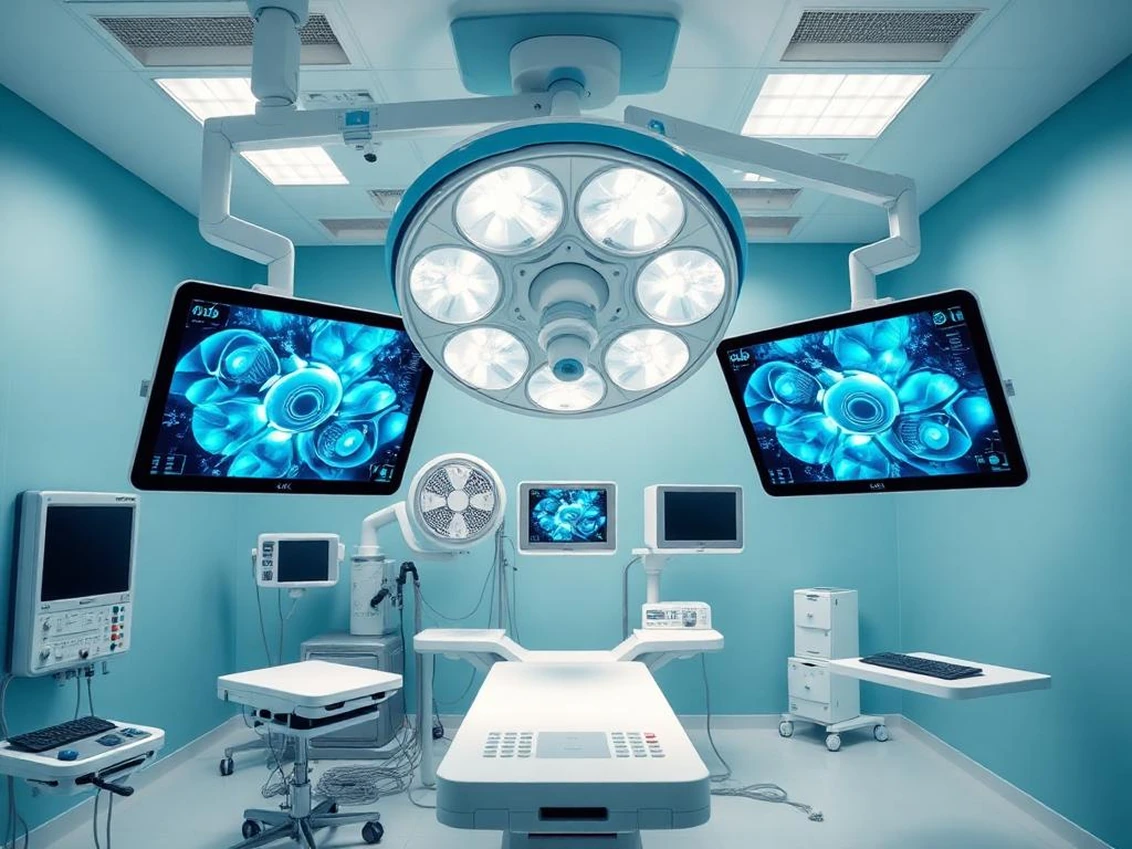
The Growing Bandwidth Demands of 4K and 8K Medical Imaging
Surgical imaging has come a long way in a short time.
Ten years ago, HD video was the benchmark. Today, 4K is becoming the standard in endoscopy suites and surgical visualization systems. 8K is entering the conversation – and AI-assisted imaging, which processes and analyzes live video feeds in real time, is adding a whole new layer of data demand on top of all of it.
The cameras, processors, and displays have kept pace with this evolution. In many hospitals, the infrastructure connecting them hasn’t.
That gap matters more than it might seem. A surgical imaging system is only as good as the signal it can reliably deliver. And if the cables and connectors carrying that signal were designed for a world of HD video and copper transmission, they’re increasingly becoming the weakest link in a system that everything else has outgrown.
This article explains what the shift to 4K and 8K imaging actually means for connectivity – in plain terms – and what a connectivity infrastructure built for where imaging is going actually needs to look like.
How Much Has Imaging Actually Changed?
The numbers tell the story clearly.
The global 4K medical imaging market was valued at over US$1 billion in 2024 and is projected to more than double to US$2.62 billion by 2033, growing at a CAGR of 10.44%. That’s not a niche trend – it’s a broad market shift already underway.
The preference for 4K resolution over previous generations is clear: it enables surgeons to make more precise diagnoses and perform more complex procedures with greater confidence. The clinical benefits are real and measurable – better tissue differentiation, improved depth perception during minimally invasive procedures, and the ability to catch details that lower-resolution imaging misses.
The global endoscopy cameras market is expected to grow from approximately USD 1.77 billion in 2025 to USD 4.84 billion by 2035, reflecting a CAGR of 10.6% – driven by rising demand for minimally invasive surgical procedures and continuous advancements in imaging technology.
And this is before accounting for AI. Looking forward to 2025–2035, the industry is likely to see a transformation with AI-enhanced image analysis, 3D endoscopy, and robotic-compatible camera systems. These applications don’t just display video – they analyze it, layer data on top of it, and send it to multiple destinations simultaneously. Every one of those functions increases the bandwidth demand on the connection infrastructure.
The imaging technology has made its leap. The question is whether the connectivity supporting it has done the same.
What Higher Resolution Actually Demands From Your Infrastructure
This is where the conversation often gets vague. “Higher resolution requires more bandwidth” is technically true but not very useful by itself. Let’s make it specific.
Resolution and Bandwidth: The Real Numbers
Every step up in resolution is not a modest increase – it’s a significant jump in how much data has to move through the system every second.
|
Resolution |
Approximate Raw Data Rate |
|
HD (1080p) |
~3 Gbps |
|
4K (UHD) |
~12 Gbps |
|
8K |
~48 Gbps |
Going from HD to 4K roughly quadruples the data load. Going from 4K to 8K quadruples it again. And these numbers represent a single video stream – a single camera feed, a single display link.
In a real surgical environment, it’s never just one stream.
The Multi-Stream Reality
A modern surgical visualization system doesn’t carry one signal from point A to point B. It carries multiple simultaneous signals – and each one needs bandwidth.
A typical 4K setup in an advanced OR might include:
- Camera head to processor (live 4K feed)
- Processor to main surgical display
- Processor to secondary display or assistant monitor
- Recording system capture
- Streaming to a remote consultation room or teaching environment
Each of those is a separate data path. Each one needs reliable, high-speed transmission. And in a robotic surgery system, you add telemetry data, control signals, and potentially multiple camera feeds on top of that.
Despite the growing availability of 4K endoscopic systems, integration into routine surgical practice remains limited in part due to bandwidth constraints and legacy infrastructure. That’s not a problem with the cameras. It’s a problem with what’s carrying the signal.
Where Traditional Connectivity Runs Into Trouble
Most existing OR connectivity infrastructure was built around copper cabling. It worked fine for the bandwidth demands of the previous generation. For today’s requirements – and tomorrow’s – it has real limitations.
Bandwidth Ceilings
Copper-based systems were designed for a world of HD video and relatively modest data rates. At 4K, they’re operating near their limits in many configurations. At 8K, they simply cannot carry the required bandwidth reliably over the distances involved in a surgical suite.
This isn’t a theoretical concern. Relying on traditional copper-based systems forces IT teams into a costly and disruptive “rip and replace” cycle every five to seven years – a model that’s no longer viable in healthcare, where infrastructure must have longer service lives and where downtime can have serious clinical consequences.
Signal Degradation Over Distance
Copper cables lose signal strength over distance. In a small room, this may be manageable. But in a large hybrid OR – or when signals need to travel to adjacent recording rooms, consultation suites, or remote locations – the degradation becomes a real quality issue.
For surgical imaging, “signal degradation” isn’t an abstract technical metric. It shows up as image noise, color inaccuracy, or frame drops on a screen a surgeon is actively using to guide a procedure.
Electromagnetic Interference (EMI)
Operating rooms are electrically dense. Electrosurgical units, imaging equipment, patient monitors, and power systems all generate electromagnetic fields. Copper cables are susceptible to EMI, which can introduce noise and interference into video signals running through the same environment.
Industries like healthcare rely on systems that process medical imaging data in real time, requiring data to flow seamlessly – and fiber networks are uniquely suited to meet these demands. Fiber optics is inherently immune to electromagnetic interference. Light doesn’t care about the electrical environment around it.
Scaling Creates More Problems
Here’s the compounding issue with copper: every new imaging device, every new display, every new recording channel typically requires its own cable run. More devices mean more cables, more connectors, more potential failure points – and more maintenance complexity.
When a hospital upgrades from HD to 4K, or adds a second display, or integrates a recording system, the infrastructure grows with each change rather than absorbing it. That’s an unsustainable model for environments that are continuously adding capability.
What a Future-Ready Connectivity Backbone Actually Requires
Let’s define the problem before describing the solution.
A connectivity system built for modern and next-generation medical imaging needs to do four things well:
Handle high bandwidth. Multiple simultaneous 4K and 8K streams, with headroom for AI-assisted processing and future resolution increases. Bandwidth requirements will not go down.
Maintain signal integrity. Consistent, clean transmission without degradation from distance or electrical interference. Surgical imaging is not a use case where “good enough” is acceptable.
Scale without adding proportional complexity. New devices, new channels, new applications should be addable without a wholesale infrastructure redesign.
Fit the physical reality of the OR. Compact, manageable, with reduced cable bulk. The physical environment has constraints that a data center doesn’t.
Fiber optics addresses all four. The question is which fiber architecture meets the medical-specific requirements.
Why Fiber Optics Belong in Medical Imaging Infrastructure
Fiber optics aren’t new technology. But they’re becoming the clear choice for medical imaging connectivity for reasons that align directly with where imaging is going.
Bandwidth That Scales With Imaging
A single optical fiber can carry data at rates well beyond what any current medical imaging application requires. Depending on the transceiver and protocol used, a single fiber channel can support 10 Gbps, 25 Gbps, or higher. That means a 4K video stream – which requires roughly 12 Gbps – is entirely manageable on a single fiber channel even before any compression is applied.
For an 8K stream at ~48 Gbps, multiple fiber channels can be combined within a single connector to carry the load. The bandwidth capacity is not the constraint.
Complete EMI Immunity
Fiber carries light, not electrical signals. That means it generates no electromagnetic interference and is unaffected by it. In an OR environment full of electrical equipment, this is a fundamental advantage – not a minor benefit.
Signal quality on a fiber connection doesn’t vary based on what else is running in the room. That consistency is exactly what surgical imaging requires.
Stable Over Distance
Unlike copper, fiber doesn’t significantly degrade over the distances relevant in medical environments – from camera to processor, processor to display, OR to adjacent recording room or remote consultation suite. The signal that goes in is the signal that comes out.
A Smaller, Lighter Physical Footprint
Fiber cables are thinner and lighter than equivalent copper cables. In an OR where cable management is already a challenge, that physical difference matters. Fiber cabling is slimmer, lighter, and easier to install, which helps reduce dust and disruption during setup.
Understanding 16-Fiber Architecture: What It Means in Practice
The opticalCON® HYBRID MED from Neutrik carries up to 16 individual fiber channels – plus 2 power contacts – within a single hybrid connector. Understanding what 16 fibers actually means for imaging capacity is worth taking a moment on.
Each Fiber Is a Separate Data Channel
Think of each fiber as a separate lane on a highway. Each one carries its own data stream independently. More fibers means more total capacity – and more flexibility in how that capacity is used.
At 10 Gbps per fiber:
- A 4K video stream (~12 Gbps) can be carried on 1–2 fibers
- An 8K stream (~48 Gbps) can be carried on 5 fibers
- The remaining channels are available for additional streams, control data, and future expansion
What 16 Channels Enables for a Real Imaging System
|
Application |
Estimated Fiber Channels Required |
|
Single 4K surgical feed |
1–2 fibers |
|
Dual 4K feeds (e.g., main + assistant display) |
2–4 fibers |
|
4K recording + streaming simultaneously |
3–5 fibers |
|
8K primary feed |
4–5 fibers |
|
AI-assisted image processing data |
1–2 additional fibers |
|
Control and telemetry signals |
1–2 fibers |
Across a full 16-channel connector, there’s sufficient capacity for a comprehensive advanced imaging setup – multiple 4K streams, recording, streaming, AI processing data, and control signals – with channels to spare for future applications.
That spare capacity is the point. Single-mode fiber supports today’s speeds while being fully prepared for faster rates in the future. Building infrastructure with headroom means not having to replace it every time imaging capabilities advance.
Power Included
The HYBRID MED’s two power contacts mean that in many configurations, a single connection handles both the imaging data and the low-voltage power delivery – eliminating a separate power cable run entirely. For OEM engineers designing medical platforms, that’s a significant simplification of the cable architecture at the device level.
Where This Makes the Biggest Difference: Real Use Cases
Endoscopy Systems
In the field of gastrointestinal endoscopy, there has been dramatic upgrades in quality and function related to optics, including the use of high-definition 4K imaging with various digital image enhancement technologies.
Endoscopy is one of the most data-intensive surgical imaging applications. The camera head captures at 4K or higher. The signal goes to a processing unit. The processed image goes to one or more displays. A recording system may capture simultaneously. A second stream may go to a teaching monitor.
That’s four separate high-bandwidth paths from a single endoscopy tower – all of which need reliable, low-latency transmission. A 16-fiber hybrid connector can handle all of them within a single connection point.
Robotic Surgery Platforms
Robotic surgery systems are among the most bandwidth-intensive environments in medicine. Multiple camera feeds (often stereo 3D at 4K), real-time telemetry, control signals, and surgeon console video all need to coexist on the same infrastructure.
The global minimally invasive medical robotics, imaging and visualization systems and surgical instruments market was valued at USD 50.69 billion in 2024, expected to reach USD 109.45 billion by 2032. As robotic platforms proliferate, the connectivity demands they place on OR infrastructure will only increase.
A hybrid fiber + power architecture built into the robotic system at the design level simplifies what the customer receives – fewer separate connections, cleaner cable routing, and a single connector spec to manage rather than several.
Hybrid ORs and Imaging-Integrated Surgical Suites
Hybrid ORs combine advanced surgical capability with imaging systems – CT scanners, C-arms, MRI equipment – in a single room. The number of devices requiring high-bandwidth connectivity in these environments is significant. Every additional display, every additional recording channel, every additional imaging modality adds to the data load.
In hybrid OR design, every cable that can be eliminated or consolidated is a safety improvement and a workflow improvement. A single 16-fiber hybrid connector replacing multiple separate runs directly reduces the cable density around the surgical field.
AI-Assisted Imaging: The Emerging Bandwidth Driver
This is the piece that makes the future-readiness argument most important. AI applications in surgical imaging – real-time tissue analysis, instrument tracking, anomaly detection – don’t just display video, they analyze it in real time. That analysis generates data that needs to be transmitted, processed, and returned to displays as augmented imaging overlays.
AI applications depend heavily on symmetrical bandwidth – the ability to move massive amounts of data in and out simultaneously. Healthcare relies on AI to process medical imaging data in real time, requiring vast amounts of data to flow seamlessly. This shift fundamentally changes how businesses must approach their connectivity, making fiber networks uniquely suited to meet these demands.
As AI becomes a standard feature in surgical imaging platforms, the infrastructure carrying imaging data needs to support not just the video feeds but the AI processing layer built on top of them. That’s an additional bandwidth demand that existing copper-based infrastructure was not designed to accommodate.
Who This Matters To, and Why
Medical OEM Engineers
If you’re designing a surgical imaging system, the connectivity architecture is a long-term design decision with a significant impact on the end customer’s experience.
A platform built around hybrid fiber + power connectivity gives your customers a simpler installation, fewer separate cable runs to manage, and an infrastructure that won’t need to be replaced when they upgrade from 4K to 8K or add AI processing capability.
The HYBRID MED Chassis integrates into Neutrik’s established D-shape cutout – meaning OEM engineers can adopt the HYBRID MED architecture without redesigning existing panel layouts. The HYBRID MED Breakout Cable supports 4x, 6x, 8x, and 16x LC breakout configurations, giving design engineers flexibility in how individual fiber channels are distributed within the device.
Biomedical Engineers
From a maintenance and lifecycle perspective, the argument for fiber over copper in high-bandwidth medical imaging is straightforward: fiber infrastructure doesn’t need to be replaced when imaging resolution increases. The bandwidth was already there.
A facility that installs hybrid fiber connectivity today for 4K systems is not buying itself a five-year runway before needing another infrastructure upgrade. The same connector that supports a 4K system today supports an 8K system tomorrow and whatever comes after that.
Hospital Technology Planners and Decision Makers
Infrastructure decisions in hospitals have long tails. Equipment goes in and stays in for years. Getting the connectivity right – building it around the bandwidth requirements of where imaging is going, not where it was – is one of the decisions that determines whether a facility can keep pace with clinical technology or spends the next decade managing the consequences of an underspecified install.
A single network outage can cost $208,600 in direct revenue from canceled appointments and delayed procedures, not to mention the risk to patient care. Connectivity reliability in imaging-intensive environments is a financial argument as much as a clinical one.
Conclusion: Don’t Let Connectivity Be the Bottleneck
Surgical imaging is advancing quickly. 4K is already the standard in many environments, 8K is on the near horizon, and AI is about to add a significant new layer of data demand on top of both.
The cameras, displays, and processors handling this evolution are being designed for where imaging is going. The question is whether the infrastructure connecting them is too.
Fiber optic hybrid connectivity – 16 channels of high-bandwidth optical fiber combined with integrated power delivery in a single ruggedized connector – is built for this environment. It handles the bandwidth demands of today’s imaging platforms, leaves room for tomorrow’s, and eliminates the cable accumulation that makes OR infrastructure harder to manage with every added device.
The opticalCON® HYBRID MED is Neutrik’s answer to this challenge – designed specifically for medical environments, with lensed PRIZM® MT optics that reduce maintenance, a glove-compatible push/pull design for clinical handling, and validation data covering 10,000 mating cycles and long-term cleaning resistance.
Infrastructure built for what’s next doesn’t need to be replaced when next arrives.
Explore the opticalCON® HYBRID MED →
Evaluating connectivity for a new platform design or an imaging suite upgrade? Contact Neutrik to discuss technical specifications and integration options.