
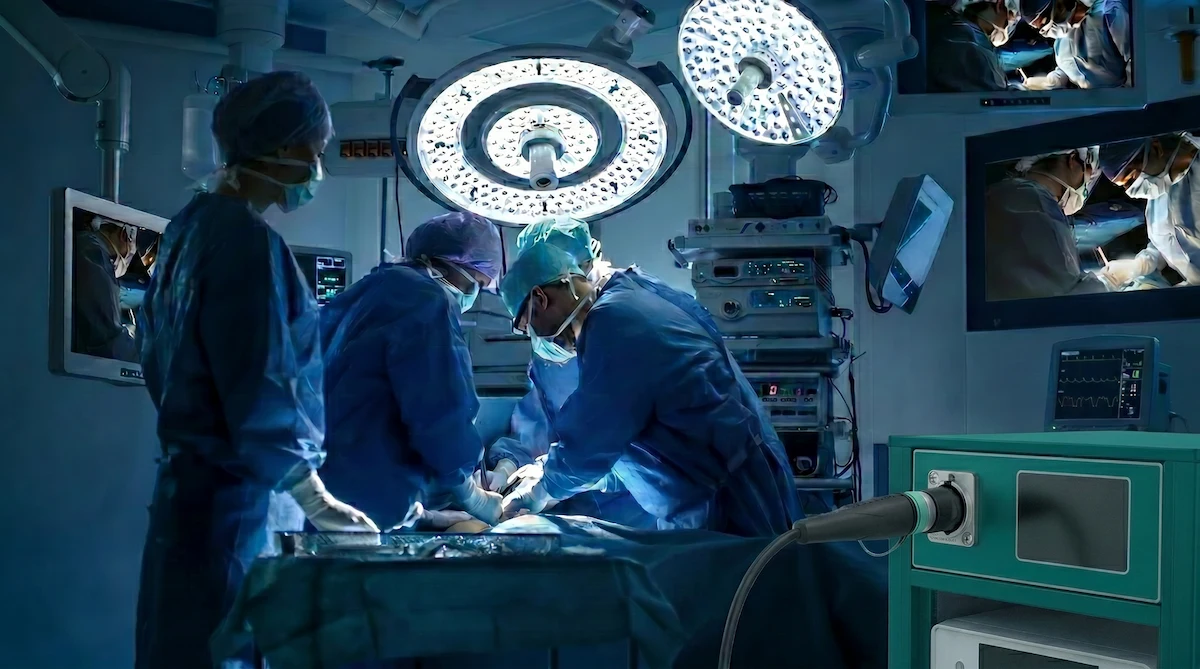
The Hidden Connectivity Challenge Inside Modern Operating Rooms
Modern operating rooms are technological marvels. Robotic surgery systems. 4K endoscopy towers. AI-assisted imaging. Real-time telemetry streaming to consult rooms down the hall.
But underneath all of that progress, there’s a problem most OR teams know intimately: the cables.
Behind every surgical tower is a dense, tangled web of fiber runs, power lines, and video cables – each one added as another device was introduced, each one managed separately. As technology in the OR has grown smarter, the infrastructure holding it together has mostly stayed the same.
More devices. More cables. More complexity.
The issue isn’t that hospitals are buying bad equipment. It’s that the way OR connectivity is typically designed hasn’t kept pace with how much data and power are now needed to flow through a surgical environment. Separate power runs. Separate fiber runs. Separate video lines. Each one is routed, labeled, and maintained independently, multiplying both the setup burden and the number of things that can go wrong mid-procedure.
It doesn’t have to work that way.
The OR’s Cable Problem Is Bigger Than It Looks
It’s easy to dismiss cable clutter as an inconvenience. It isn’t.
Research published on ResearchGate in a systematic review of OR connectivity issues found that approximately 22% of cables and connections in the operating room have documented malfunctions – and that around 64% of OR staff report experiencing problems caused by cables and connections. In robotic surgery specifically, cable and connection issues occur at an average incidence of 42%.
That’s not just frustrating. That’s a patient safety variable.
A robotic surgery coordinator quoted in a clinical challenges report by Team Consulting put it plainly: “This is our biggest headache because there’s lots of kit that has to be joined together using cables. We just need to make sure that everybody is safe and not going to trip over them.”
Safety: The Problem Hiding in Plain Sight
Every cable on the OR floor is a trip hazard. Surgeons, circulating nurses, scrub techs, and anesthesiologists all share the same floor space – often moving quickly and under pressure.
Loose cables restrict movement. They create confusion during critical moments. And in an environment where a stumble can disrupt a procedure mid-step, that’s a serious risk that doesn’t show up on most equipment procurement checklists.
Infection Control: Cables Are Harder to Clean Than You Think
Cables that run across OR floors pick up contamination. Connectors, jacket surfaces, and junction points all create areas that are difficult to sterilize properly between cases.
The CDC estimates that hospital-acquired infections (HAIs) affect nearly 1.7 million patients annually in the US. Anything that makes post-case cleaning harder is working against infection control. Fewer cables – and fewer surfaces to disinfect – makes that job simpler.
Operational Efficiency: The Costs Add Up
Setup and turnover time matters. The OR is one of the most expensive operational environments in a hospital, and delays eat directly into case capacity.
Structured cable management has shown a measurable impact: according to findings cited in The Journal of Healthcare Engineering, healthcare facilities that implemented structured cable management systems saw a 30% reduction in downtime associated with device malfunctions.
Every minute saved in setup or troubleshooting is a minute that goes back to patient care.
Why the Problem Keeps Getting Worse
Here’s the thing – this isn’t a static problem. It’s getting harder every year.
Operating Rooms Are More Complex Than Ever
A modern advanced OR can require 40 or more network ports just to accommodate current technology needs, according to healthcare cabling infrastructure standards (ANSI/TIA-1179). That’s a number most facilities weren’t originally designed around – and that number keeps growing.
Hybrid ORs now combine imaging systems with surgical environments in a single room. That means CT scanners, C-arms, MRI equipment, and surgical visualization systems all coexisting in the same space – each with its own connectivity demands, its own power requirements, and its own set of cables trailing across the floor.
An OR integration system can help consolidate control and visualization, but it doesn’t eliminate the underlying physical cabling infrastructure. All those devices still need to be physically connected, and every connection is a point that can fail, be accidentally disconnected, or need servicing.
The device ecosystem of a typical advanced OR today includes:
- Endoscopy systems and camera processors
- Robotic surgery platforms
- Surgical displays and video routing systems
- Intraoperative imaging (C-arm, CT, MRI)
- Patient monitoring and recording systems
- OR integration control panels
Each of those brings cables. Most of them bring more than one.
4K and 8K Imaging Changed the Bandwidth Equation
Surgical visualization has moved decisively toward ultra-high definition. Surgeons performing minimally invasive procedures depend on clear, detailed, real-time video. Robotic platforms render at 4K or higher. Next-generation endoscopy systems are following.
Higher resolution means higher data throughput. Traditional copper-based cabling was never designed to carry these loads cleanly – especially in environments dense with electromagnetic interference from imaging systems and monitoring equipment.
Robotic Surgery Platforms Multiply the Challenge
A single robotic surgery system brings significant data and power requirements into the OR. It requires reliable, high-bandwidth connections for video, telemetry, and control systems – plus power delivery to the system itself.
As these platforms grow in adoption, the cable density around the surgical field grows with them. And the coordination required to manage it safely – before, during, and after each case – grows with that.
This is compounded by the footprint of robotic systems. The patient cart, vision cart, and surgeon console together occupy significant floor space. The cables connecting them need to be routed in ways that don’t restrict the movement of the surgical team, don’t create trip hazards, and can be disconnected cleanly at the case end without the kind of tangling that slows turnover.
EMI: The Problem Copper Can’t Fully Solve
Operating rooms are electrically dense environments. MRI, CT, fluoroscopy, electrosurgical units, and patient monitoring systems all generate electromagnetic fields. Running copper-based data and video cables through this environment introduces real risks of signal interference – degraded image quality, data transmission errors, or outright signal loss at the worst possible moment.
Fiber optics are inherently immune to electromagnetic interference. That’s not a minor benefit in an OR. It’s one of the strongest technical arguments for moving toward fiber-based connectivity infrastructure in surgical environments where imaging quality is directly tied to patient outcomes.
Why Traditional Connectivity Models Can’t Keep Up
The conventional approach to OR connectivity is additive. Every new device gets its own cable run: a separate line for power, a separate line for data, a separate line for video.
|
Traditional Multi-Cable Approach |
Problem |
|
Separate power cables |
Increases cable count linearly |
|
Separate fiber data runs |
Multiplies connection points |
|
Separate video lines |
More failure points per system |
|
Copper-based infrastructure |
EMI susceptibility in crowded OR |
|
No consolidation |
Higher maintenance burden |
There’s no consolidation happening. Every new device adds to the total rather than integrating into it.
Copper-based systems bring their own limitations. They’re bulkier. They’re susceptible to electromagnetic interference – a meaningful issue in OR environments running imaging systems alongside surgical equipment. And they have real bandwidth ceilings that 4K and 8K applications are already pushing against.
The result is that adding more technology to the OR increasingly means adding more cables, more connectors, more potential failure points, and more things for OR staff to manage. That’s not a sustainable trajectory.
What Smarter Connectivity Actually Means
The answer isn’t a cable management system. It’s a connectivity design that doesn’t generate the problem in the first place.
Hybrid connectivity means a single cable system that carries both optical fiber (for high-bandwidth data transmission) and electrical conductors (for power delivery) – replacing multiple separate runs with one.
That’s a fundamentally different approach to OR infrastructure.
Optical fiber brings immediate advantages over copper in this environment:
- High bandwidth – capable of supporting UHD 4K and 8K transmission without degradation
- EMI immunity – fiber doesn’t pick up or generate electromagnetic interference
- Smaller footprint – fiber cables are lighter and less bulky than equivalent copper runs
Combine that with integrated power delivery, and you’ve reduced what was previously two or three separate cable runs into a single, managed connection.
How Hybrid Fiber + Power Connectivity Changes OR Operations
The practical impact of switching to a hybrid connectivity architecture shows up in several places at once.
Fewer Cables, Cleaner Setup
Replacing multiple separate runs with a single hybrid line reduces the physical volume of cabling behind and around equipment. That means less to route, less to secure, and less to audit during pre-case checks.
Fewer Trip Hazards, Safer Floor Space
Fewer cables on the OR floor means fewer hazards for a team that’s constantly moving. This directly addresses one of the most consistently cited safety concerns from clinical staff.
Faster Turnover Between Cases
Fewer connections to make – and fewer to verify – speeds up the setup process between cases. When a connection problem does occur, there are fewer variables to troubleshoot.
Better Reliability
Every connection point is a potential failure point. Fewer connection points mean fewer opportunities for wear, misseating, or contamination to interrupt a procedure.
Infrastructure Ready for What’s Next
A hybrid fiber system built for 4K and 8K doesn’t need to be replaced when imaging technology advances further. The bandwidth is already there.
The opticalCON® HYBRID MED: What This Looks Like in Practice
Neutrik’s opticalCON® HYBRID MED is a purpose-built implementation of hybrid connectivity for medical environments.
|
Specification |
Detail |
|
Fiber channels |
Up to 16 multimode (via 1 lensed MPO connector) |
|
Power contacts |
2 power contacts + 1 ground contact |
|
Optical technology |
PRIZM® MT lensed optics |
|
Signal support |
UHD 4K and 8K |
|
Mating cycle rating |
10,000 cycles |
|
Locking mechanism |
Glove-protected push/pull |
|
Housing |
Ruggedized all-metal, EMI-shielded |
A few things worth calling out specifically:
The PRIZM® MT lensed optics are a meaningful design choice. Unlike physical-contact fiber connectors, lensed optics don’t require the fiber end-faces to touch at the connection point. The lens surface area is substantially larger than a standard physical-contact surface, which means the system is far less sensitive to dust and contamination. In an OR environment – where connectors get handled frequently and cleaned repeatedly – that matters.
The push/pull locking mechanism is glove-protected by design. OR staff aren’t stopping to remove their gloves to manage a connection. The connector handles the way it needs to in actual clinical conditions.
The D-shape chassis design matches Neutrik’s established chassis cutout dimensions, which means the HYBRID MED Chassis integrates directly into existing system architectures without bespoke panel modifications. For OEM engineers, that simplifies the design-in process significantly.
For facilities or manufacturers who need a more compact fiber-only solution for certain applications, Neutrik’s opticalCON® QUAD MED offers a 4-channel LC-based option in the same ruggedized medical housing.
Who Benefits – and How
Different stakeholders in the OR ecosystem experience these improvements differently.
OR Managers and Perioperative Coordinators see faster case turnover, simpler pre-procedure setup checks, and fewer incidents tied to cable misidentification or connection failures. The floor is cleaner. Staff can move more freely. When a case finishes, the breakdown process is simpler – fewer lines to disconnect, fewer items to trace back to their source. Over a high-volume surgical schedule, that saved time compounds quickly.
Biomedical Engineers and Maintenance Teams benefit from a simplified maintenance picture. Fewer distinct cable types to inventory. Fewer connectors to inspect on a maintenance cycle. A system rated for 10,000 mating cycles doesn’t need frequent replacement. And when something does need attention, fewer total connection points means faster diagnosis.
There’s a lifecycle cost argument here, too. A facility managing a mixed infrastructure of copper power cables, separate fiber runs, and dedicated video lines is managing multiple inventory SKUs, multiple service relationships, and multiple failure modes. Consolidating to a hybrid system simplifies all of that – and gives procurement teams a cleaner total cost of ownership story.
Medical OEM Engineers have the most significant design opportunity here. Integrating hybrid connectivity at the platform level – rather than leaving customers to manage separate power and data runs – reduces system complexity for the end user, simplifies cable assembly, and future-proofs the architecture against bandwidth demands that will only grow. The HYBRID MED Connector and Breakout Cable provide the component-level building blocks for this integration.
For OEMs, the D-shape chassis integration also matters commercially. A connector system that drops into an established chassis footprint means less re-engineering of existing panel designs when adopting the hybrid architecture. That lowers the barrier to adoption significantly.
Connectivity Is a Patient Safety Issue – Not Just a Technical One
It’s worth framing this clearly.
Cable failures mid-procedure are not hypothetical. Connectivity issues that disrupt visualization, interrupt telemetry, or cause unexpected equipment behavior during surgery are events that require improvised responses from a team that should be focused entirely on the patient.
And these failures don’t always announce themselves clearly. A partially seated connector might pass a pre-case check and fail under the vibration of a busy OR. A cable worn from repeated handling might degrade signal quality gradually – introducing noise into an imaging feed before it fails outright. These are the kinds of issues that multiply when connection points multiply.
Infrastructure decisions made at the design or procurement stage have a long tail. The OR equipment specified today will run cases for years. Getting the connectivity architecture right – building it around consolidation, reliability, and realistic clinical conditions – is one of the decisions that makes everything downstream easier.
The Joint Commission’s Environment of Care standards (EC.02.05.01) specifically address equipment and patient safety in clinical spaces. Cable management and connectivity reliability are part of that compliance picture – not an afterthought.
When connectivity is designed well, it disappears. The OR team doesn’t think about cables because cables aren’t the problem. That’s the standard to aim for.
The Bottom Line
Operating rooms don’t need more cables. They need a different approach to how data and power get from one place to another.
Hybrid fiber + power connectivity consolidates what was previously a collection of separate runs into a single, managed system. That means less clutter, fewer hazards, faster setup, and infrastructure that’s ready for 4K, 8K, and whatever imaging standards come after.
The technology to do this is available now.
Explore the opticalCON® HYBRID MED system →
Interested in evaluating hybrid connectivity for a specific OR platform or OEM application? Contact Neutrik to discuss technical specifications and integration options.